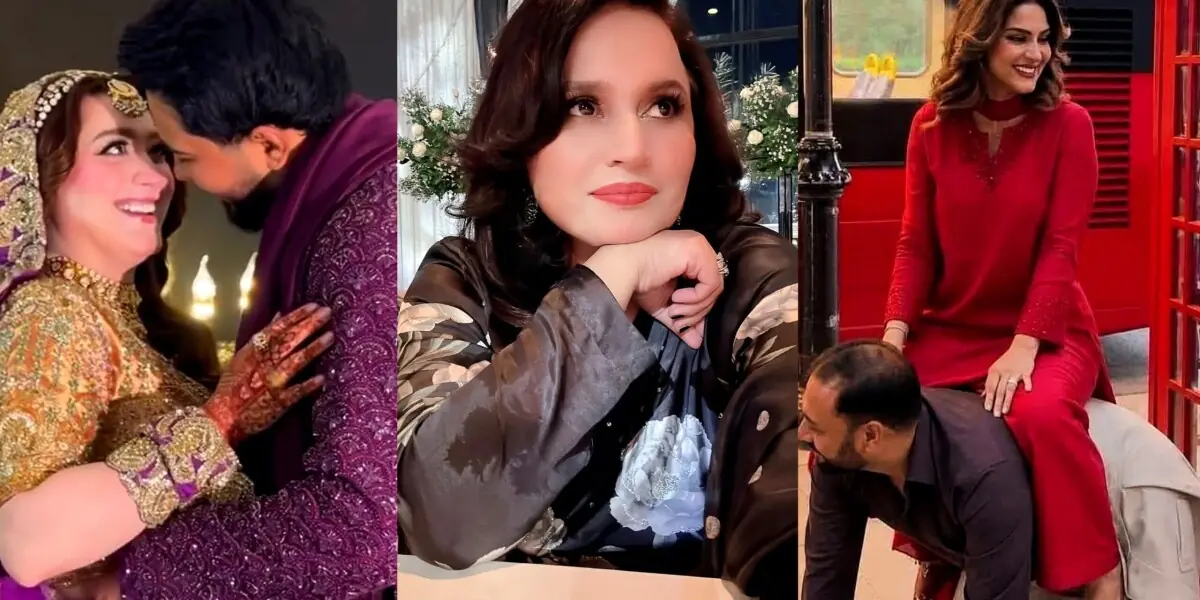
Saima Akram Chaudhry Ignites Debate: Unpacking 'Desperate' Public Displays by Fiza Ali & Momina Iqbal

In the ever-watchful world of celebrity, where personal lives often become public spectacles, a prominent voice has emerged to critique what she perceives as an unsettling trend. Renowned writer and producer Saima Akram Chaudhry has recently sparked a significant conversation, openly criticizing actresses Fiza Ali and Momina Iqbal for what she terms their ‘desperate behaviour’ with their husbands in the public eye.
Chaudhry’s comments have resonated across social media and entertainment circles, drawing attention to the delicate balance public figures navigate between sharing their lives and maintaining a sense of privacy and dignity. Her critique specifically targets the manner in which Ali and Iqbal reportedly present their relationships, suggesting an overt, perhaps even attention-seeking, display of affection or dependence that crosses a line.
The essence of Chaudhry’s argument appears to hinge on the perception of authenticity versus performance. In an era dominated by social media and constant digital scrutiny, celebrity couples often face immense pressure to curate an image of domestic bliss or passionate romance. While some view these public displays as genuine expressions of love, others, like Chaudhry, interpret them as a calculated effort to garner attention or maintain relevance, potentially bordering on desperation.
This debate is not new, but Chaudhry’s direct naming of prominent figures like Fiza Ali and Momina Iqbal has brought it to the forefront. It compels a broader discussion about the evolving dynamics of celebrity relationships, the impact of social media on personal boundaries, and societal expectations regarding public decorum, particularly in a cultural context where overt public displays of affection can sometimes be viewed with skepticism.
The critique raises important questions: Where is the line between celebrating a relationship and exploiting it for public consumption? Do celebrities have a responsibility to present their private lives with a certain level of restraint? And how do these public perceptions influence the audience, particularly younger generations who often look to these figures as role models?
As the conversation continues to unfold, Saima Akram Chaudhry’s bold stance serves as a powerful reminder that even in the most glamorous of industries, authenticity and perceived dignity remain highly valued, and the public’s gaze is always discerning.

 0 Comments
 Print
Print








What do you think