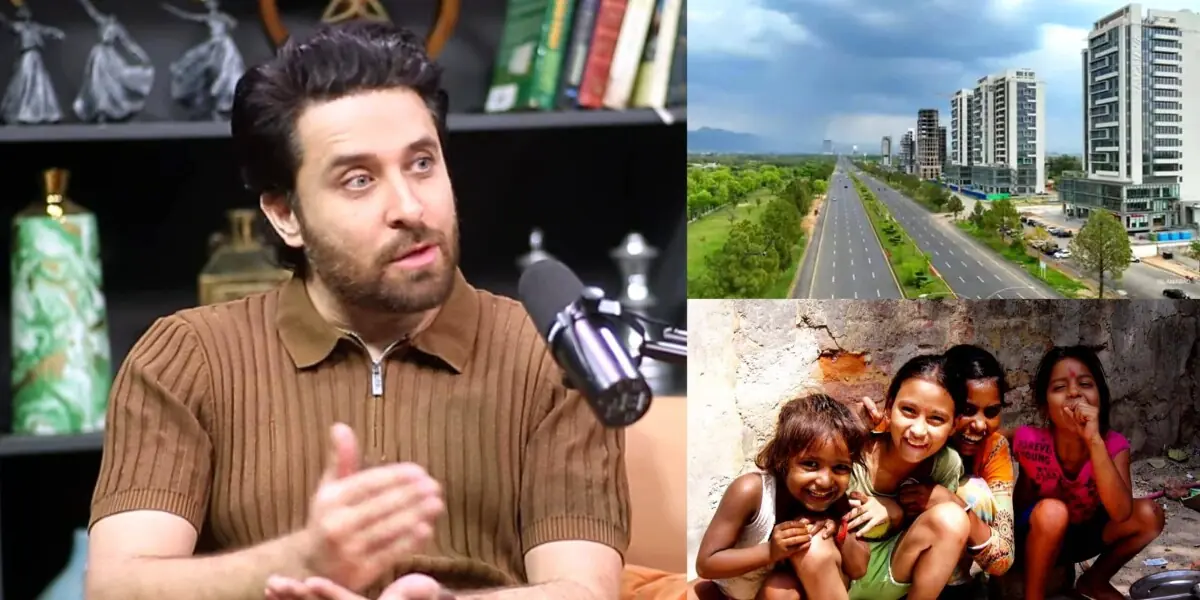
Beyond Borders: Haroon Shahid Ignites Fiery Debate on Pakistan's Development Edge Over India

A recent statement by actor and musician Haroon Shahid has sent ripples across social media and beyond, sparking a fervent debate about the comparative development trajectories of Pakistan and India. Shahid’s assertion that Pakistan is “much more developed” than its eastern neighbor has prompted both staunch agreement and sharp criticism, forcing a closer look at the multifaceted indicators of national progress.
Shahid’s comments arrive at a time when both nations are navigating complex economic, social, and political landscapes. Pakistan, for its part, has been actively pursuing ambitious infrastructure projects designed to bolster its economic standing. A cornerstone of these efforts is the China-Pakistan Economic Corridor (CPEC), an extensive master plan that envisions transforming the nation’s connectivity and industrial capacity. Key segments, such as the western route inaugurated in Zhob, underscore a tangible commitment to modernizing vital trade and transport links across the country.
However, the narrative of development is rarely monolithic. While Pakistan celebrates its advancements, regional comparisons often present a more intricate picture. For instance, analyses have, at times, pointed to how neighboring Bangladesh has managed to surpass Pakistan in certain development metrics, suggesting that progress is not always linear or uniform across South Asia. These discussions highlight the diverse challenges and opportunities inherent in nation-building.
Beyond economic indicators, development also encompasses social and cultural evolution. Pakistan’s cultural landscape continues to be vibrant and reflective of its societal dynamics. The film industry, for example, has produced impactful works like ‘Verna,’ a movie that bravely confronted sensitive themes of power, politics, and sexual violence, demonstrating a willingness to engage with critical social issues through art. Education, too, sees moments of exceptional achievement, with Pakistani students occasionally setting global benchmarks, such as the remarkable instance of a student securing an unprecedented 47 As in O and A levels, showcasing individual academic excellence.
Furthermore, the nation grapples with its historical identity, as evidenced by the ongoing appreciation of the ancient Indus Valley civilization, often intertwined with broader attempts to shape and understand its rich, pre-partition past. This cultural introspection is a crucial aspect of a developing society, fostering a deeper sense of identity and heritage.
Haroon Shahid’s provocative statement undoubtedly serves as a catalyst for discussion, compelling observers to look beyond superficial comparisons and delve into the nuanced realities of development in both Pakistan and India. While the debate over which nation holds a ‘development edge’ is likely to continue, it undeniably shines a spotlight on the continuous efforts and unique challenges faced by each country on its path to progress.

 0 Comments
 Print
Print







What do you think